
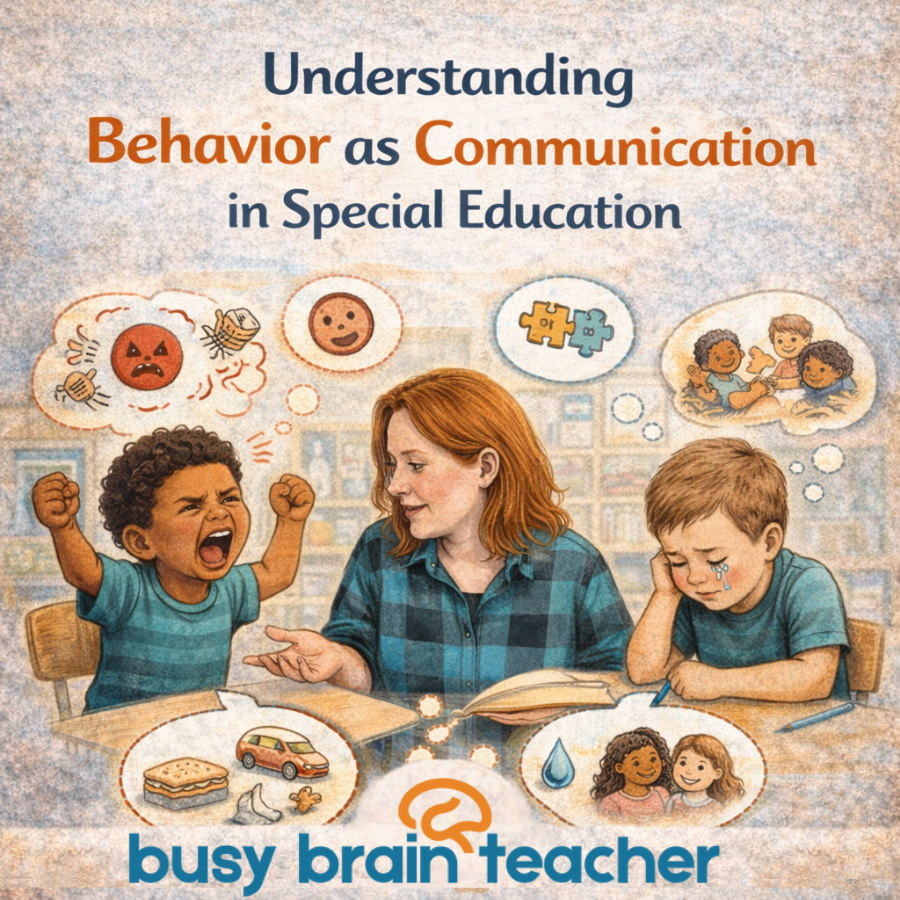
One of the most important mindset shifts in special education is understanding that behavior is communication. This sounds simple, but in real classrooms, it can be hard to remember. When a student refuses work, yells, shuts down, or walks out of the room, it can feel personal or disruptive. Most of the time, however, students are not trying to be difficult. They are trying to tell us something using the tools they currently have. When we learn to read behavior as communication, we move from reacting to behavior to understanding students.
Why Behavior Is Communication
Every behavior serves a purpose. Students do things because something is happening inside their body, brain, or environment that they are trying to manage. Some students communicate with words, while others communicate through actions, avoidance, escalation, or shutting down. Many students in special education are still developing the skills needed to say things like, “This is too hard,” “I am overwhelmed,” or “I don’t understand what to do.” When those skills are still developing, behavior often becomes the message.
What Students Might Be Communicating
A student refusing work may be communicating that the task feels impossible, confusing, or too big to start. A student who is loud or disruptive may be communicating that they feel unsafe, ignored, overstimulated, or frustrated. A student who shuts down may be communicating exhaustion, overwhelm, anxiety, or fear of failure. A student who leaves the area may be communicating that their body needs space, movement, or relief from sensory input. When adults pause and ask what the behavior might mean instead of immediately focusing on how to stop it, better solutions usually follow.
Behavior Still Has Consequences
Understanding behavior does not mean ignoring it, and it does not mean there are no expectations or accountability. All behavior has outcomes, and students need to learn that their choices impact their environment, their learning, and the people around them. Consequences are most effective when they are predictable, connected to the behavior, and focused on learning rather than punishment.
For example, if a student throws materials, a logical consequence might include helping clean up and practicing a safer way to ask for help or a break. If a student damages materials, part of the consequence may involve repairing, replacing, or losing access to those materials for a period of time. The goal is not to shame students but to teach responsibility, problem solving, and safer replacement skills. Students can be supported and held accountable at the same time.
The Difference Between Attention-Seeking and Connection-Seeking
Students are often labeled as attention-seeking, but many are actually connection-seeking. Connection is a basic human need, and students who feel disconnected often try to regain connection in the fastest way they know how. Sometimes that looks like humor, sometimes disruption, and sometimes conflict. When connection increases, many behaviors decrease naturally because students feel seen, safe, and supported.
Why Punishment Alone Rarely Works
Punishment may stop a behavior in the moment, but it does not teach the missing skill. If a student is struggling with emotional regulation, executive functioning, language processing, or sensory overload, consequences alone do not build the skills they need to succeed next time. Students need to learn what to do instead, not just what not to do. Without replacement skills, the behavior often returns because the original need is still there.
Teaching the Replacement Skill
If behavior is communication, then part of our job is to teach better ways to communicate. If a student throws materials when overwhelmed, they may need to learn how to request a break. If a student refuses work, they may need support learning how to ask for help or how to break work into smaller steps. If a student shuts down, they may need co-regulation support or a predictable way to re-enter work. When replacement skills are taught and practiced during calm moments, students are more likely to use them during stressful moments.
Environment Matters More Than We Think
Sometimes behavior is not only about the student but about the environment around them. Noise levels, lighting, visual clutter, unclear expectations, or unpredictable transitions can all increase stress and behavior challenges. When environments become more predictable, more visual, and more structured, many behaviors decrease without direct behavior intervention because students feel safer and more prepared.
Progress Takes Time
Learning new regulation and communication skills takes repetition, patience, and consistency. Students may understand a skill but still struggle to use it when they are overwhelmed. That does not mean they are choosing the behavior. It often means their brain is in survival mode. Skill use grows with support, practice, and safe relationships built over time.
What This Looks Like Day to Day
In real classrooms, this often means pausing before reacting, looking for patterns, and asking what happened before, during, and after the behavior. It also means celebrating small growth. A student asking for help instead of shutting down is progress. A student using a break card instead of leaving the room is progress. A student attempting work after frustration is progress because growth in special education often happens in small, meaningful steps.
For Parents: Behavior Is Communication at Home Too
Behavior at home often looks different than behavior at school, and that does not mean someone is doing something wrong. Many students use all of their energy holding it together during the day and release that stress in their safest space at home. Predictable routines, clear expectations, and calm adult responses can help students feel safe enough to build new skills over time.
Final Thoughts
Seeing behavior as communication does not mean ignoring behavior. It means understanding it so we can respond in ways that actually help students grow. Students do well when they can, and when they cannot, they need support along with appropriate consequences that teach responsibility and skills.
When we focus on teaching skills instead of only reacting to behavior, we build independence, confidence, and long-term success. When students feel understood, they are far more likely to succeed.