
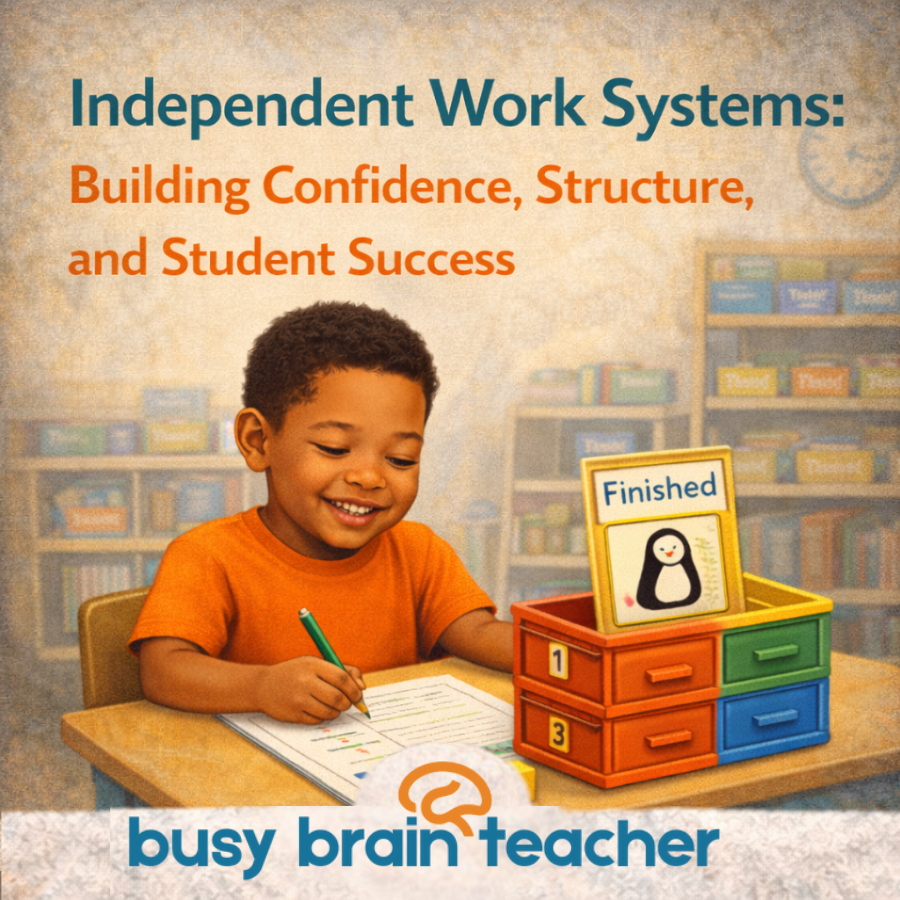
Independent work systems are are powerful tools in a classroom. While they are often associated with special education, the truth is they benefit every learner. When independent work systems are designed well, they lower anxiety, increase engagement, and help students develop real independence. In busy classrooms, especially ones with a wide range of needs, predictability is not just helpful, it is essential. Students learn best when they know what is expected and when they feel safe enough to focus on learning instead of worrying about what comes next.
One of the biggest indicators that a classroom needs an independent work system is when students constantly ask, “What do I do next?” That question is not usually about the work itself. It is about uncertainty. Independent work systems remove that uncertainty by giving students a clear path forward.
An independent work system is simply a structured way for students to understand:
- What work they are doing
- How much work they are responsible for
- How they will know when they are finished
- What they should do after they finish
When those four pieces are clear, students can move through work with confidence instead of hesitation. For many students, especially those with autism, ADHD, anxiety, or executive functioning challenges, this clarity lowers stress and makes learning feel achievable instead of overwhelming.
I remember early in my teaching career working with a student who would shut down almost every time independent work was assigned. He was bright, capable, and understood the content when we worked together, but the moment he was asked to work independently, he would freeze. At first, it looked like refusal. What I eventually realized was that it was fear. He did not know where to start, how long the work would take, or what would happen when he finished.
Once we built a simple independent work system using three clearly labeled tasks and a visual “finished” bin, everything changed. Within a few weeks, he was starting work without prompting. Within a few months, he was helping other students understand the routine. That moment shifted how I approached independent learning forever.
Independent work systems matter because they build skills students need for life, not just school. Students develop planning skills, task completion habits, and self-monitoring skills. They begin to rely less on adults for constant direction and more on their own understanding of routines and expectations. Behavior challenges often decrease because many behaviors are rooted in uncertainty or overload. When students know exactly what is expected, they can focus their energy on learning instead of coping.
When independent work systems are effective, they tend to be:
- Visually clear
- Consistent from day to day
- Predictable for students
- Explicitly taught
- Practiced regularly
These systems are not something students are expected to figure out on their own. Just like academic skills, independence is taught through modeling, practicing together, providing light support, and slowly removing that support over time. It is also completely normal to reteach systems after breaks, schedule changes, or long absences. That is not failure. That is how learning works.
There are many ways independent work systems can look in real classrooms. Some classrooms use task boxes or bins where students physically move through activities. Others use checklists or work strips that guide students through multi-step assignments. Older students often benefit from digital systems built into learning platforms or structured digital workflows. The format matters less than the clarity and consistency behind it.
One of the most common mistakes teachers make, and I include myself in this, is making systems too complicated. When we try to include too many tasks, too many visuals, or too many changes, students lose the predictability that makes the system work. Simple systems are almost always more effective and easier to maintain over time.
Independent work systems are especially powerful for students with autism because they support how many of these students naturally process information. Strong systems often:
- Provide routine and predictability
- Reduce verbal overload
- Support visual processing strengths
- Build confidence and autonomy
When students understand the structure of their day and their work, they can focus more energy on learning and less on navigating uncertainty.
When independent systems are working well, you start to notice small but meaningful changes. Students begin work faster. Transitions become smoother. Shutdown moments decrease. Students take pride in finishing tasks. Sometimes, students even begin helping each other learn the routines. One of the best moments as a teacher is watching a student realize they can complete work on their own without fear or confusion.
If you are new to independent work systems, starting small is the best approach. Many teachers find success by starting with:
- A small number of tasks
- The same location each day
- The same visual format
- A consistent finishing routine
Once students trust the system, you can build from there.
Independent work systems are not about making students work alone. They are about giving students the structure they need to feel confident enough to work independently. When students feel safe and capable, learning happens faster and lasts longer. And maybe most importantly, students begin to believe in their own ability to succeed.