
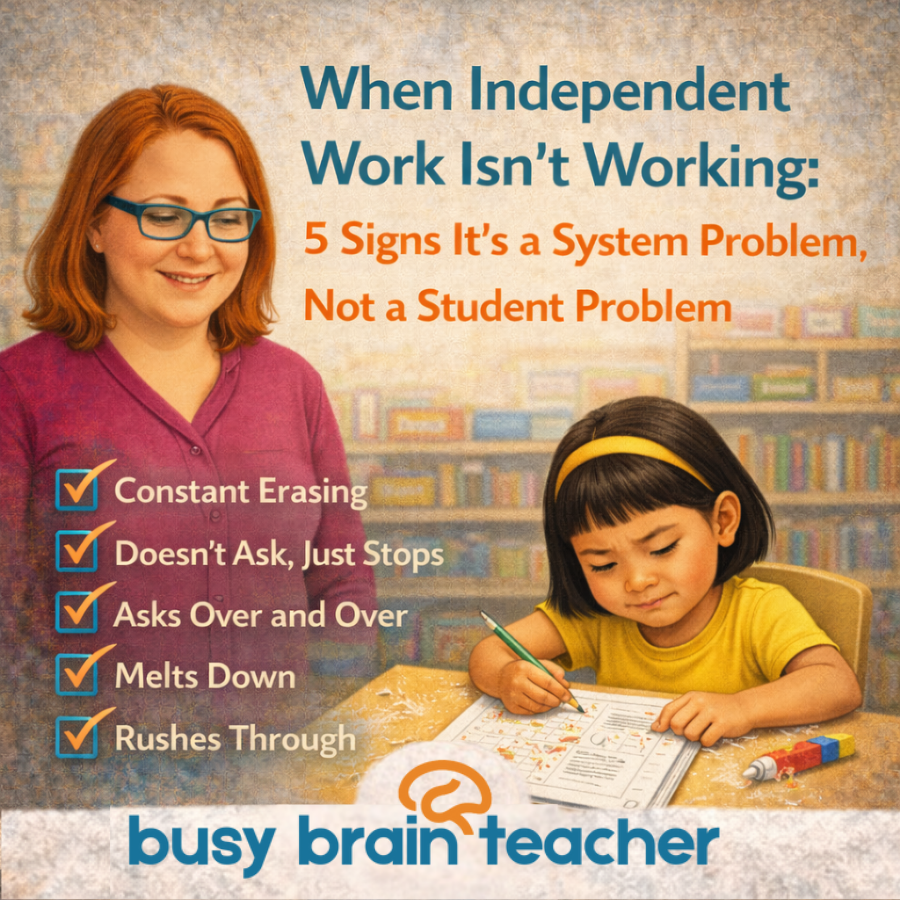
I once worked with a student who almost never finished independent work. She would start, erase, restart, and erase again. At first, it looked like she was wasting time. What I eventually realized was that she was afraid to be wrong. Once we built a system that showed when work was “done enough” and gave her a clear finished routine, her completion rate changed increased greatly.
The Reality of Independent Work in SPED and Support Classrooms
Independent work is not only about academic skill. It also depends on predictability, emotional safety, cognitive load management, clear starting points, and clear expectations for completion. When one or more of these pieces are missing, students may struggle to begin, continue, or complete tasks successfully. This often shows up as behavior, but the root cause is usually uncertainty.
Sign 1: The Student Does Not Start the Task
This may look like staring at the paper, avoiding eye contact, repeatedly sharpening a pencil, or asking unrelated questions. Often, this means the student does not know how to begin, is afraid of making a mistake, or does not understand the first step but does not know how to ask for help.
System supports that help:
• Add a visual start marker
• Highlight the first problem
• Use “Do this first” prompts
• Model how to begin the task
Sign 2: The Student Asks Constant Questions During Independent Work
You may hear repeated questions like “Is this right?”, “What do I do next?”, or “Are we done yet?” In many cases, this means the student does not trust the structure yet or does not understand what completion looks like.
System supports that help:
• Use numbered task systems
• Use visual checklists
• Use a consistent finished bin system
• Post time expectations visually
Sign 3: The Student Has Big Reactions When Independent Work Begins
This can look like arguing, crying, shutting down, or refusing to participate. Often, this is connected to cognitive overload, fear of failure, or past negative experiences with independent work.
System supports that help:
• Reduce the number of tasks
• Shorten work time expectations
• Build early success experiences
• Gradually increase independence
Sign 4: The Student Rushes Through Work With Low Accuracy
This often appears as finishing suspiciously fast, guessing, or skipping sections. Many times, this is an attempt to escape the task or avoid feeling unsuccessful.
System supports that help:
• Teach quality expectations visually
• Add a “check before finished” step
• Reinforce correct process, not just completion
Sign 5: The Student Only Works When an Adult Is Next to Them
If a student stops working when you walk away, they may be relying on adult presence for executive function support. This is common and does not mean the student is being defiant.
System supports that help:
• Gradually fade adult support
• Replace verbal prompts with visual supports
• Use consistent routines daily
Independent Does Not Mean Unsupported
Students are not automatically independent just because they are given independent work. Independence is taught through structure, visuals, and predictable routines. When those systems are strong, independence develops much faster and with less frustration for both students and teachers.
What Students Need Before They Can Work Independently
Students need clear answers to the following:
• Where do I start?
• What do I do next?
• How long will this take?
• What does finished look like?
• What happens after I finish?
When these questions are consistently answered through systems instead of repeated teacher explanations, students gain confidence and begin working more independently.
Final Thoughts
If independent work is not working, it is worth stepping back and looking at the system before assuming the student is unwilling or unable. When systems are predictable and clear, students are much more likely to engage, complete work, and build true independence.